
RABBIT ACTIVITY
As regular visitors will have noticed, rabbit activity is causing holes on the hard core tracks and whilst we try and in-fill them, please be aware that the tracks are more uneven than normal as a result of the rabbit diggings.
TRAFFIC REGULATION ORDER – MARSH LANE, HAMPTON IN ARDEN
Please note that with effect from 20th January 2021 Marsh Lane, Hampton in Arden will be gated just north of the railway bridge which accesses the Marsh Lane Nature Reserve car park, to the west of Siden Hill Wood. The gate is going to be locked overnight. Solihull Council have deemed this has become necessary due to frequent problems of anti-social behaviour, fly-tipping and other forms of environmental crime at Bradnocks Marsh.
The closing/opening times will be as follows:
- 1st April – 30th September 9 p.m. to 7 a.m.
- 1st October – 31st March 6 p.m. to 8 a.m.
Link to West Midland Bird Ringing Group: https://www.westmidlandsringinggroup.co.uk/
WORK PARTY DATES 2026
Saturday 21 February – 2.00pm
Saturday 21 March – 2.00pm
Tuesday 21 April – 6.00pm
Tuesday 19 May – 6.00pm
Tuesday 16 June – 6.00pm
MARSH LANE TRAFFIC ARRANGEMENTS
Starting from March/April 2026, and lasting about 9 months, there will be amended traffic arrangements on the A452/Kenilworth Road. These relate to the alterations that are taking place whereby the dual carriageway will rise over the forthcoming (God only knows when!) HS2 and a new junction with Marsh Lane is being formed. Use of the new section will commence shortly.
At that junction, a roundabout is due to be constructed and, in due course, Marsh Lane will be accessed off that roundabout. In the meantime, some lane closures will take place, but Marsh Lane and the Lorry Park will always be accessible. Signposting will hopefully mention the Nature Reserve but if not follow the signs for the Lorry Park.
HS2 WORKS – A452 KENILWORTH ROAD
Please note there is a temporary closure of lane one on the northbound carriageway of the A452 between the Bradnock’s Marsh roundabout and the Meriden roundabout. This was originally in place until Friday 20 February, but due to recent adverse weather conditions impacting the work, the temporary closure has been extended until 6.00pm on Friday 6 March.
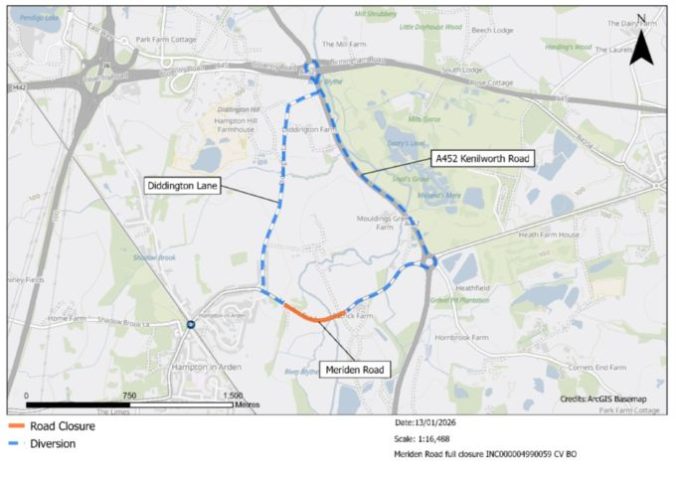
CLOSURE OF THE B4102, MERIDEN ROAD – MONDAY 23 FEBRUARY – SUNDAY 8 MARCH 2026
As part of ongoing works to construct the River Blythe Viaduct, the Meriden Road will be closed from Monday 23rd February to Sunday 8th March 2026. The road closure will be in place between 8.00am and 6.00pm, Monday to Friday, with a signposted diversion route in place throughout the closure as shown below. The work is programmed for two weeks but, if it progresses well, the road will reopen as soon as it is safe to do so.
CORMORANT, RED 9J
A Cormorant, Red 9J, seen on Car Park Pool on 2nd February was ringed as a nestling at Vogelmeer in the coastal dunes south of Bloemendaal, the Netherlands, on 16th June 2025 and was seen there again on 7th August. There have been no other reports.
28th February 2026
Overcast, fresh north-westerly, severe flooding from the Blythe across the Flood Plain and into both pools.
Hardly surprising to see so much water this morning after the torrential overnight rain.
Plenty of wildfowl were enjoying the floods, including a pair Goosanders.
The Bittern showed well both in the morning and the afternoon in the North Causeway Bay where it has taken a liking to the breeding Frogs.
A Chiffchaff was fly catching behind the North Causeway hide in the afternoon, and there were also two Lesser Redpolls there at one stage during the day.
Other counts today were as follows: Five Mute Swans, 26 Canadas, 38 Greylags, three Shelduck, 10 Shoveler, five Gadwall, 85 Wigeon, 14 Mallard, 25 Teal, a drake Pochard, 38 Tufted Ducks, 25 Cormorants, three Little Grebes, three Little Egrets, two Herons, two Moorhens, 27 Coot, eight Oystercatchers, 52 Lapwing, 950 Black-headed Gulls, one Common Gull, four Herring Gulls and 10 Lesser Black-backed Gulls.
Fifteen Redwings were feeding in the Back Gate Copse, and another four came into roost in the Causeway area in the evening.
Both a female Goosander and a female Pintail arrived on Car Park Pool in the late afternoon, and a Grey Wagtail also flew over.
27th February 2026
Overcast, light rain and drizzle, light north-westerly.
Water Rails and Bitterns were both seen or heard in the North Causeway Bay and the Reedbed, whilst on the pools there was a Redshank, eight Oystercatchers, three Goosanders and a Shelduck. A Great Spotted Woodpecker was drumming in the Crop Field Oaks.
26th February 2026
Overcast, blustery south-westerly.
Further arrivals today comprised a pair of Pintail on Car Park Pool. The male was photographed with what appeared to be a ring, as if it had been applied from captivity. However, it seemed particularly wild and has attracted an unringed female.
An Otter was seen on the Reedbed this morning, along with both Bitterns, whilst on Car Park Pool there was a pair of Shelduck, a first-winter drake Goosander and three Little Egrets.
25th February 2026
Sunny spells, fresh southerly.
Continuing signs of spring today saw a single Chiffchaff by the Car Park, a particularly early arriving bird, and two Avocets on Railway Pool, whilst overhead, a pair of Red Kites provided added excitement, along with the continuing presence of the White-fronted Goose. A Peregrine also appeared over the Reserve, the male Stonechat replaced the female at the Dragonfly Pond and there were two Shelducks and a drake Pochard.
24th February 2026
Sunny spells, fresh southerly.
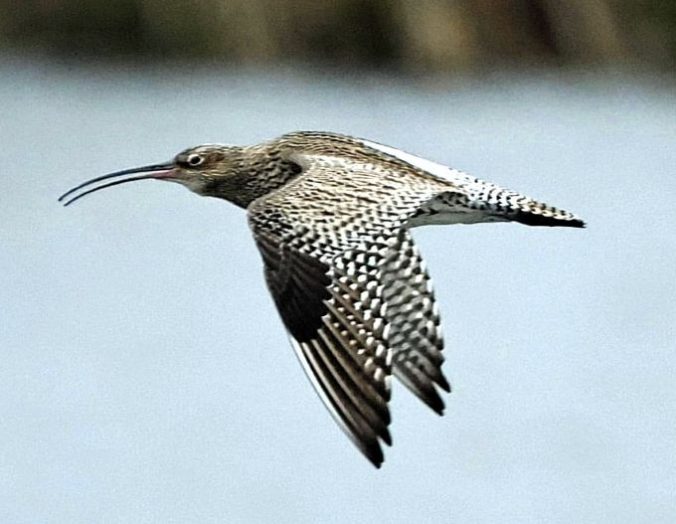
The advancing spring saw the arrival of firstly one, and then a second Curlew, identified as a male and female on size. They appeared initially on Car Park Pool and then moved to feed on the Flood Plain, along with the first Redshank of the year.
Yesterday’s first-winter Russian White-fronted Goose was also present on Car Park Pool, along with a pair of Goosanders. Five Siskins were in the Alders on the Central Stream, and the male Stonechat has been replaced by a female.
Curlew – Photograph by Steve Pattison
23rd February 2026
Sunny spells, fresh westerly.
Today’s quality came in the shape of a first-winter White-fronted Goose in amongst the Greylags on the grassland.
A male Stonechat, unringed, was present at the Dragonfly Pond, whilst overhead, a Raven flew across the Reserve. Two Bitterns were in the North Causeway Bay, with a bird also seen early morning in the Reedbed.
The small white flower appearing on the side of the paths and around the Car Park feeders is Common Whitlow Grass, one of the earliest of the spring flowers to appear.
22nd February 2026
Light south-westerly, sunny and mild.
Aside from the usual Oystercatchers and three Little Egrets, the only additional bird making the log was a Red Kite which flew over Siden Hill Wood briefly in the late morning.
21st February 2026
Sunny spells, light south-westerly. The full count by Graham and Dave today was as follows: Three Mute Swans, 34 Canadas, two Greylags, two Shelduck, 20 Shoveler, 16 Gadwall, 310 Wigeon, 17 Mallard, 38 Teal, 26 Tufted, two female Goosanders, 37 Cormorants, a single Little Grebe, three Little Egrets, two Moorhen, 30 Coot, eight Oystercatchers, 145 Lapwings, two Snipe, 740 Black-headed Gulls, nine Common Gulls, 19 Herring Gulls, 6 Lesser Black-backed Gulls, seven Redwing (Back Gate Copse), two Collared Doves at the Car Park feeders, along with four House Sparrows.
Pleasingly, seven attended the work party and fortunately, the rain held off until just after 16.00. Two cleaned out and attended and repaired most of the tit boxes, whilst five of us concentrated on filling in the potholes on the Car Park, before physically and metaphorically immersing ourselves in the Reedbed to continue the removal of the Alders at the south end. Aside from the larger ones which are particularly visible, there are a myriad of smaller ones that have appeared on the back of the dry summer. Thanks to all those who attended.
20th February 2026
Overcast, drizzle late am, fresh south-westerly.
The Flood Plain held a small flock of thrushes comprising 12 Redwing and 13 Fieldfare. These birds are clearly moving back through with small parties appearing regularly now on other grassland, including Packington Park.
A roving flock of 20 Siskins was feeding in the Alders along the southern Central Stream, and 17 Common Gulls is one of the best counts of the winter and, again, represents birds moving through.
A single Green Sandpiper was on Patrick Farm flash and there were two Shelducks and eight Oystercatchers spread between the pools.
19th February 2026
Cloudy, drizzly on and off.
A Kingfisher was enjoying Stefan Fraczek’s stick on the Reedbed this morning, with other counts between the pools being eight Oystercatchers, at least 100 flighty Lapwing, four Shelduck, at least 25 Cormorants, 25 Tufteds and four Snipe.
18th February 2026
Thin cloud, light south-easterly.
Not a great deal of change in species today, but a decent count still of Wigeon with 330 noted. A Grey Wagtail was present on the Flood Plain.
17th February 2026
Sunny start, clouding over, light north-westerly, continuing flooding at Patrick Bridge.
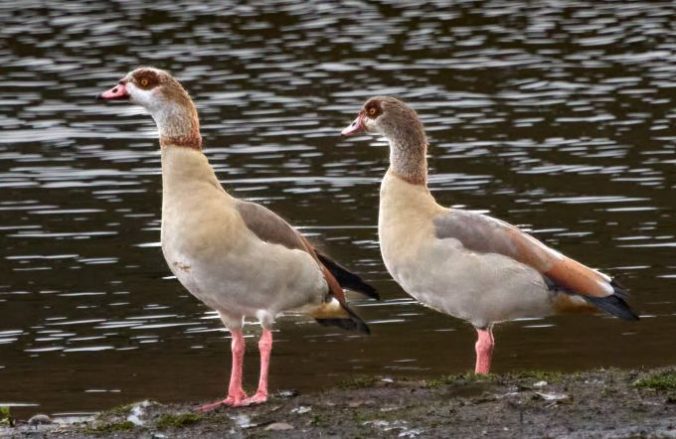
Two Egyptian Geese were new in, along with a Swan Goose and three Shelduck, whilst counts of 54 Cormorants continued the good run of roosting birds. A single Green Sandpiper was present on the Patrick Farm flash, and the Bittern was seen on the Reedbed.
Egyptian Geese – Photograph by Bob Breach
16th February 2026
Sunny spells, showers, fresh westerly, continuing flooding at Patrick Bridge.
The female Pintail was again seen on Car Park Pool with just the female Stonechat at the Dragonfly Pond. Both Mistle Thrushes were present by Car Park Hide, and there were eight Oystercatchers spread between the pools, along with six Mute Swans.
15th February 2026
No records.
14th February 2026
Sunny, light north-westerly, flooding at Patrick Bridge.
The full count today, care of Graham and Dave, was as follows: A single Mute Swan, 69 Canadas, one Canada Greylag hybrid, 46 Greylags, two Shelduck, 15 Shoveler, 27 Gadwall, 224 Wigeon, 11 Mallard, 46 Teal, a drake Pochard, 29 Tufteds, 39 Cormorants, four Little Grebe, two Herons, two Little Egrets, one Bittern, three Moorhen, 28 Coot, six Oystercatchers, 176 Lapwing, one Snipe, 291 Black-headed Gulls, seven Common Gulls, two Herring Gulls, one Lesser Black-backed Gull, two Ring-necked Parakeets in Siden Hill Wood, a Kingfisher on the Reedbed, a Cetti’s Warbler heard by Railway Hide, three Fieldfares on the Flood Plain, two Mistle Thrushes in the Oaks by Car Park Hide and a Raven over.
Other records later in the day included a Nuthatch in Siden Hill Wood and two Goosanders on the Flood Plain with a Grey Wagtail.
At 17:30 the roosting Goosander flock had increased to 10, five males and five females, and the Bittern was seen to go to roost.
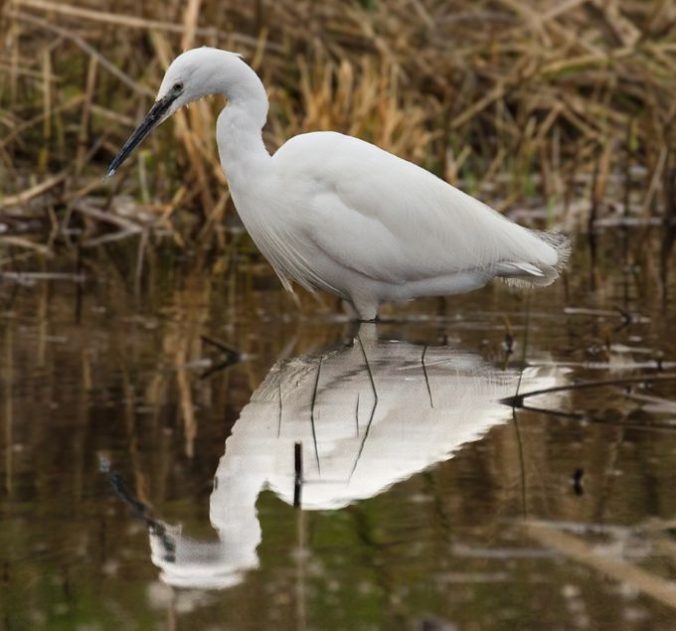
Little Egret – Photograph by Stef Fraczek
13th February 2026
Overcast, showers, fresh north-easterly. Flooding still at Patrick Bridge.
Both Green Sandpipers were seen on the flash north of Patrick Farm this morning. A pair of Mistle Thrushes were again present around Car Park Hide and 15 Siskins fed in the Alders along the Central Stream. Two Shelduck, four Oystercatchers and three Little Egrets were the other birds in the logbook.
12th February 2026
Cold, wet and damp.
Thirteen Goosanders and two Bitterns were present at dawn.
A female Pintail was relocated on Car Park Pool, and there were eight Oystercatchers, three Shelduck, a drake Pochard and two Kingfishers today. Other birds recorded included Great Spotted Woodpecker, Stock Dove, Buzzard, Sparrowhawk and Little Grebe.
11th February 2026
Overcast and drizzly.
A Bittern left its roost in the Reedbed at 07:10 this morning and flew over the Causeway into the North Causeway Bay area. There were seven male House Sparrows at the Car Park feeders, and a Chiffchaff in the wood pile north of the Reserve along the Old Road, in what is sometimes called the old Bale Store (an area now fenced off by HS2).
This is the time of year when the appearance of Chiffchaff is borderline between early returning migrants and over-wintering birds. Many Chiffchaffs over-winter in southern Europe and into North Africa and can return quite early, but this is still an early date and suggests a moving over-wintering bird.
There was just a single Green Sandpiper at Patricks flash this morning, two Shelduck, three Goosanders and seven Oystercatchers, along with a Great Crested Grebe on the pools and a Kingfisher was seen on Car Park Pool but does move on and around the Reedbed and the Causeway Bay area.
10th February 2026
Overcast, drizzle, still flooding at Patrick Bridge.
Brief counts today included two Mistle Thrushes in the Oaks by Car Park Hide, 11 Siskins in the South-West Pond Alders and on the pools, 128 Greylags, two Shelduck, a Great Crested Grebe and six Oystercatchers.
9th February 2026
Overcast, light south-easterly, still flooding at Patrick Bridge.
Counts today, care of Graham Rowling, were as follows: 18 Shoveler, 22 Gadwall, 11 Goosanders at dawn falling to three by mid-morning, eight Oystercatchers, a Bittern in the Reedbed, 249 Black-headed Gulls on Railway Pool, a Great Spotted-Woodpecker drumming in the Back Gate Copse, three Skylark over, the elusive pair of Stonechats back on the Dragonfly Pond, 26 Siskins in the Alders at the Old Road/Concrete Road junction, two Green Sandpipers at Patrick Farm flash, and 11 House Sparrows at the Car Park feeders, all bar one were male.
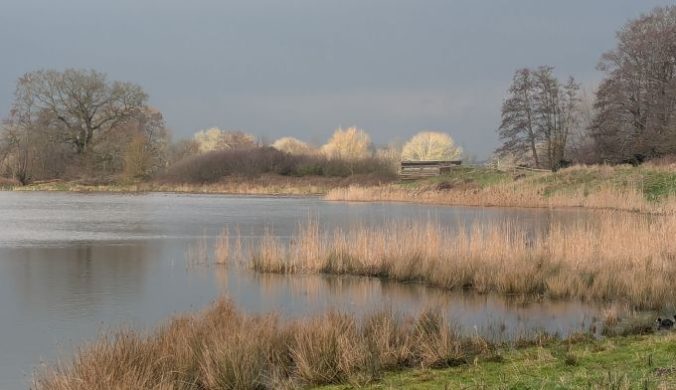
Sun catching the trees on the Flood Plain from Oak Hide – Photograph by Nick Barlow
8th February 2026
Dry, some sun.
Eight Reed Buntings could be seen perching in the top of the reeds in the Reedbed, with a further two, with at least six Chaffinches coming down to the grain under the crop Oaks. Yesterday, apparently, there was a mixed flock of 40 birds, a mixture of Chaffinches, Linnets and Reed Buntings. At least five Song Thrushes were singing away, two either side of the cottages, one north and one south of the Car Park and one by the Central Stream. A Green Woodpecker called regularly from the Central Stream Alders.
Other birds today included at least 10 House Sparrows at Patrick Farm, together with six Starlings. Whilst these birds were on show, there was a group of at least six House Sparrows still at Marsh Lane. My original theory was that the birds at the Reserve were from Patrick Farm, but with decent numbers still there, it becomes less certain. Historically, there have been birds towards the kennels to the south of the Reserve, but I am not aware of any recent records from there.
Seven Oystercatchers were spread between the pools including three on Car Park and four on Railway. There were also two Pochard, one Little Egret, a Buzzard on Lower Siden Hill Wood solar panel and two Skylarks over. Later in the morning a female Pintail was found on Car Park Pool and there were 20 Shoveler, with Oystercatcher numbers increasing to eight. A pair of Goosanders were on the floods near Patrick Bridge and a Treecreeper in the South-West Pond area.
7th February 2026
Initially overcast with rain, clearing to sunny spells, light south easterly. River Blythe flowing into Railway Pool.
A good selection of birds, despite the flooding, included 40 Redwing and seven Fieldfares on the Flood Plain, 34 Lesser Redpolls in the Back Gate Alders, seven Siskins on the Central Streamline, six males and a female House Sparrow at the Car Park feeders, two Mistle Thrushes in the Oaks left of Car Park Hide, a Skylark on the Tip Field and five Collared Doves, with four in the Crop Field Oaks and one at Patrick Farm.
The wildfowl counts, care of Graham and Dave, were 30 Mutes, 50 Canadas, 44 Greylags, eight Shoveler, 13 Gadwall, 105 Wigeon, 16 Mallard, 57 Teal, three drake Pochard, 44 Tufteds, five Goosander, 47 Cormorants, two Little Egrets, two Little Grebes, a Water Rail in the Reedbed, one Moorhen, 20 Coot, 134 Lapwing, a notable increase to six Oystercatchers, just a single Snipe, 85 Black-headed Gulls, six Common Gulls, six Herring Gulls, 28 Lesser Black-backed Gulls and the adult Greater Black-backed Gull.
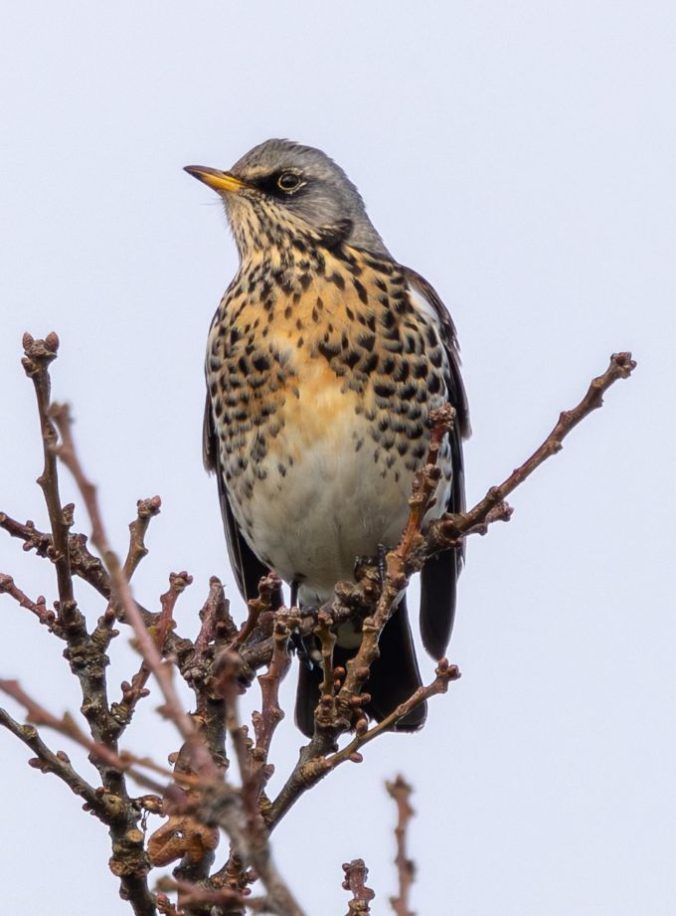
Fieldfare – Photograph by Alastair Robertson
6th February 2026
Overcast, rain, fresh easterly, extensive flooding at Patrick Bridge.
It was unsurprising that much of the Flood Plain was under water after yesterday’s heavy rain.
There were seven male House Sparrows at the Car Park feeders, 175 Lapwing across the pools, along with three Oystercatchers, a female Goosander, six Pochard. A Raven went over.
5th February 2026
Wet all day.
Two Bitterns were visible from the Reedbed screens in the early morning, and seven Goosanders roosted, two males and a female.
Only two Oystercatchers were seen first thing.
4th February 2026
Overcast, light easterly.
Not a great deal of change today, but of the three Oystercatchers, a pair were already mating on Car Park Pool.
3rdFebruary 2026
Overcast, light showers, fresh north-easterly.
A Shelduck joined three drake Pochard, three Oystercatchers and 53 Cormorants on the pools, whilst a pair of Stonechats were present on the HS2 Flood Plain fences. Four Collared Doves comprised two at Patrick Farm and two at the Car Park feeders.
2nd February 2026
Dull, 6°, light breeze.
Twelve Goosanders roosted on Car Park Pool overnight, five males and seven females, and Oystercatchers continued to arrive with three present on Railway Pool this morning. A Bittern was also seen at dawn on the Reedbed.
Other counts today included over 200 Wigeon, 36 Tufted Ducks, 10 Shoveler, seven Pochard, 120 Lapwing, 20 Teal and a pair of Mute Swans in courtship display around the Causeway. Other birds making the log were four Egyptian Geese, a Swan Goose, 51 Cormorants including a Dutch ringed bird, and an unringed male Stonechat on the Flood Plain.
Visitors to the feeders included at least three Goldfinch, Great Spotted Woodpecker, Song Thrush, and Nuthatch.
1st February 2026
Overcast, some light drizzle, but generally calm.
The elusive pair of Stonechats were again present at the Dragonfly Pond this morning, and the Bittern flew across the Reedbed from right to left at 10.15. Early dawn is still the best time.
A Peregrine flew over, there was a single Litle Egret on Railway Pool, and Oystercatcher numbers have doubled, with a pair now on Car Park Pool.
Three Pochard and 26 Tufteds were the other birds making the log.